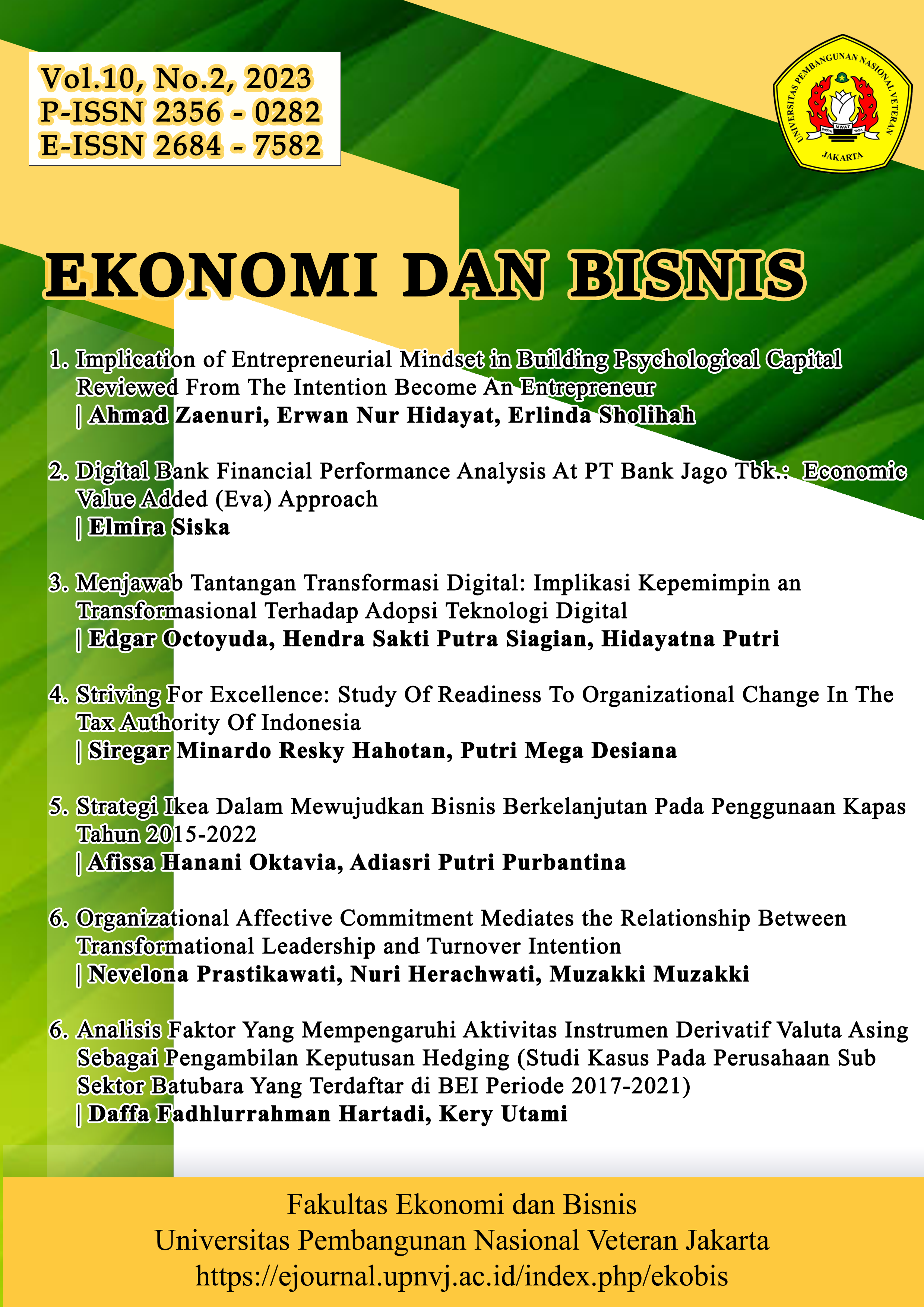
DIGITAL BANK FINANCIAL PERFORMANCE ANALYSIS AT PT BANK JAGO TBK.: ECONOMIC VALUE ADDED (EVA) APPROACH
DOI:
https://doi.org/10.35590/jeb.v10i2.6286Abstract
PT Bank Jago Tbk. is a conventional bank that has been transformed into a digital bank. Bank Jago has grown by extensively upgrading technology by creating numerous features in the Jago application after PT Dompet Karya Anak Bangsa (Indonesian Gojek Group) acquired 22 percent of Bank Jago's shares in 2020 with funds reaching IDR 2.25 trillion. Economic value added (EVA) is a methodology developed to complement and determine the true value of business performance. This study aims to analyze whether corporate action in technology modernization provides positive economic value added to the company. The research design used in this study is a non-statistical quantitative method. The research focus is on digital banks with case studies on PT Bank Jago Tbk. Data utilized in the research is secondary data sourced from the financial statements of PT Bank Jago Tbk. 2020 – 2022. Bank Jago's performance evaluation is carried out by analyzing the economic added value created from the bank's operations. The results of the study show that in 2020, Bank Jago's operations have not been able to create economic value added, but in the following periods, namely in 2021 and 2022, after Bank Jago modernizes technology and develops digital applications, bank operations will be able to provide added economic value.
Keywords: Digital Transformation Digital Bank; Financial Performance; Economic Value Added; Bank Jago
Downloads
Published
How to Cite
Issue
Section
License

This work is licensed under a Creative Commons Attribution 4.0 International License.
Authors who publish with this journal agree to the following terms:
Authors retain copyright and grant the journal right of first publication with the work simultaneously licensed under a Creative Commons Attribution 4.0 International License that allows others to share the work with an acknowledgment of the work's authorship and initial publication in this journal.
Authors can enter into separate, additional contractual arrangements for the non-exclusive distribution of the journal's published version of the work (e.g., post it to an institutional repository or publish it in a book), with an acknowledgment of its initial publication in this journal.
Authors are permitted and encouraged to post their work online (e.g., in institutional repositories or on their website) before and during the submission process, as it can lead to productive exchanges, as well as earlier and greater citation of published work.
This work is licensed under a Creative Commons Attribution 4.0 International License.