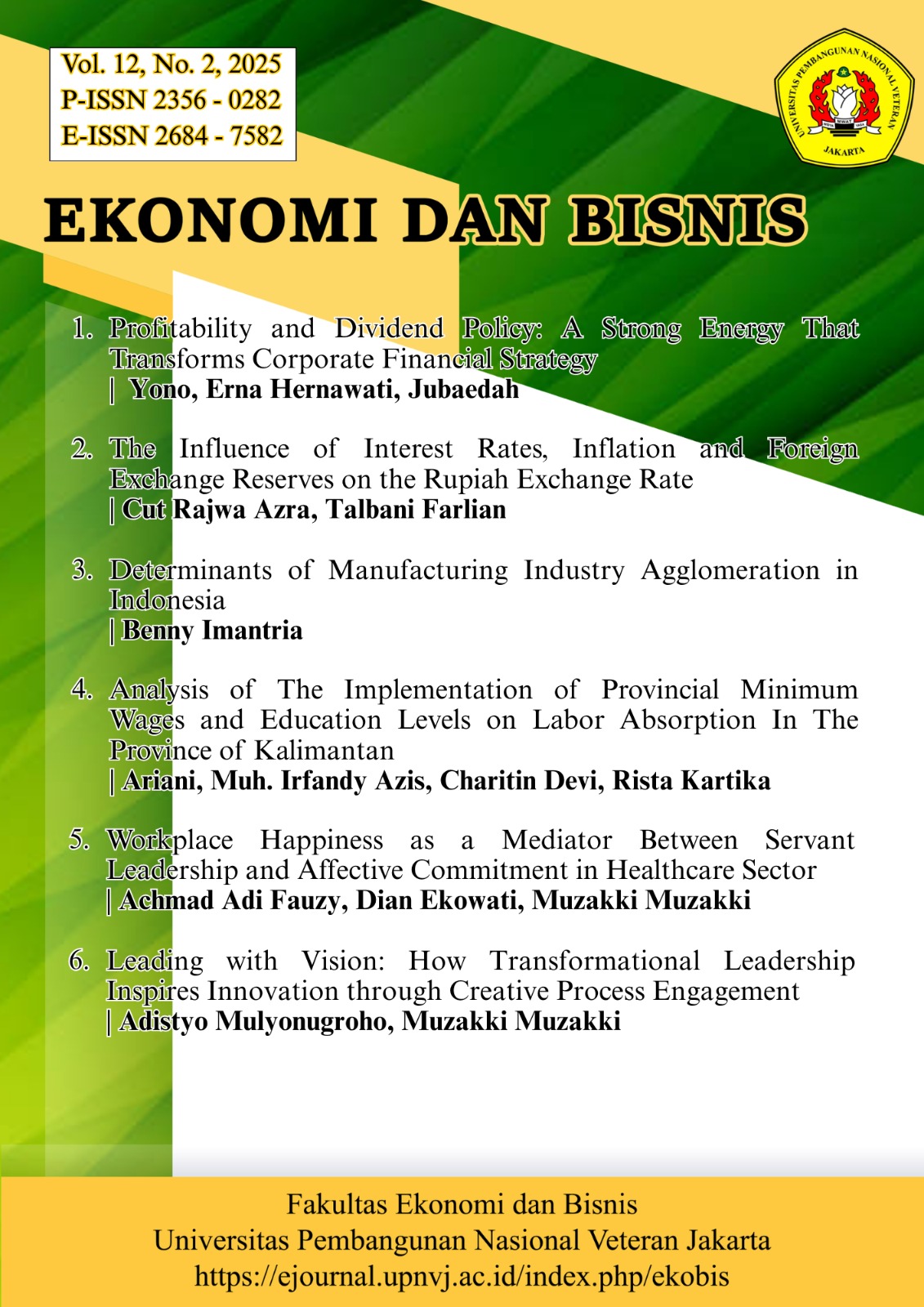
Workplace Happiness as a Mediator Between Servant Leadership and Affective Commitment in Healthcare Sector
DOI:
https://doi.org/10.35590/jeb.v12i2.9106Abstract
- Purpose: This study aims to analyze how servant leadership influences affective commitment through happiness at work both directly and indirectly.
- Design/methodology/approach: The quantitative method used was administering questionnaires to collect data from the respondents of the case nurses. The sample of this study consisted of 81 respondents selected using a random sampling technique.
- Findings: The results revealed that servant leadership has a positive but insignificant effect on affective commitment and a positive and significant effect on happiness at work. Happiness at work has a positive and significant effect on affective commitment. Happiness at work positively and significantly mediates the relationship between servant leadership and affective commitment.
- Research limitations/implications: This study has several limitations, including the use of a cross-sectional method that relies on data collected at a single point in time and the focus on the hospital sector. In addition, this study only considers a limited number of constructs influencing happiness at work and affective commitment, with a primary focus on servant leadership.
- Practical implications: Practically, the results of this study can also be used as input to hospitals and leaders in the hospital environment regarding the importance of the role of leaders, especially servant leadership, in increasing employee happiness at work and affective commitment.
- Originality/value: The results of this study can provide important contributions to science, especially in the field of human resource management, and can become one of the study materials related to servant leadership, happiness at work, and affective commitment.
- Paper type: Research paper.
Keywords: Servant leadership, affective commitment, happiness at work.
Downloads
Published
How to Cite
Issue
Section
License
Copyright (c) 2025 Achmad Adi Fauzy, Dian Ekowati, Muzakki Muzakki

This work is licensed under a Creative Commons Attribution 4.0 International License.
Authors who publish with this journal agree to the following terms:
Authors retain copyright and grant the journal right of first publication with the work simultaneously licensed under a Creative Commons Attribution 4.0 International License that allows others to share the work with an acknowledgment of the work's authorship and initial publication in this journal.
Authors can enter into separate, additional contractual arrangements for the non-exclusive distribution of the journal's published version of the work (e.g., post it to an institutional repository or publish it in a book), with an acknowledgment of its initial publication in this journal.
Authors are permitted and encouraged to post their work online (e.g., in institutional repositories or on their website) before and during the submission process, as it can lead to productive exchanges, as well as earlier and greater citation of published work.
This work is licensed under a Creative Commons Attribution 4.0 International License.