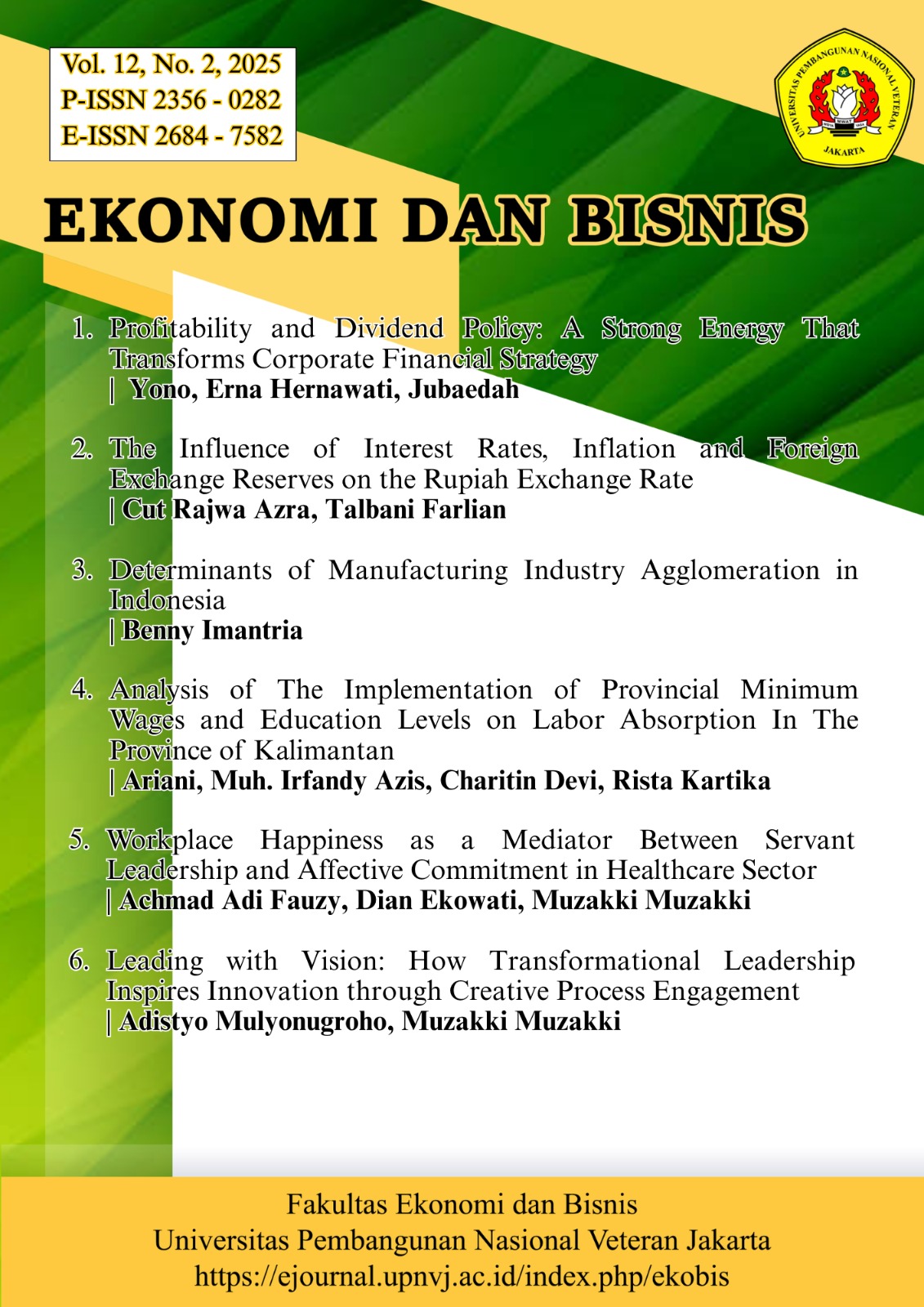
Profitability and Dividend Policy: A Strong Energy That Transforms Corporate Financial Strategy
DOI:
https://doi.org/10.35590/jeb.v12i2.9067Abstract
- Purpose: This study aims to analyze the effect of the investment opportunity set, debt policy, and business effectiveness on dividend policy with profitability as an intervening variable in consumer goods industry companies listed on the Indonesia Stock Exchange during the 2018–2022 period..
- Design/methodology/approach: This research employs a quantitative approach using secondary data. The sample was selected through purposive sampling, resulting in 24 companies over five periods (2018–2022) with a total of 120 observations. Data were analyzed using panel data regression processed with Eviews version 13.
- Findings: The results show that (1) the investment opportunity set has no effect on dividend policy, (2) debt policy has no effect on dividend policy, (3) business effectiveness affects dividend policy, (4) profitability affects dividend policy, (5) the investment opportunity set affects profitability, (6) debt policy has no effect on profitability, (7) business effectiveness affects profitability, (8) the investment opportunity set does not directly affect dividend policy through profitability, (9) debt policy does not directly affect dividend policy through profitability, and (10) business effectiveness does not directly affect dividend policy through profitability.
- Research limitations/implications: This study is limited to the consumer goods industry sector and a five-year observation period; therefore, the findings cannot be generalized to all sectors. Future research is recommended to expand the sectoral scope, extend the observation period, and include additional relevant variables.
- Practical implications: The findings provide insights for company management and investors in formulating dividend policies by considering business effectiveness and profitability as key determinants of dividend distribution decisions.
- Originality/value: This study offers empirical evidence by examining the role of profitability as an intervening variable in the relationship between the investment opportunity set, debt policy, business effectiveness, and dividend policy within the Indonesian consumer goods industry sector.
- Paper Type: This paper is a quantitative empirical research study employing panel data regression analysis.
Keywords: Investment Opportunity Set; Debt Policy; Business Effectiveness; Profitability; Dividend Policy.
Downloads
Published
How to Cite
Issue
Section
License
Copyright (c) 2025 Yono

This work is licensed under a Creative Commons Attribution 4.0 International License.
Authors who publish with this journal agree to the following terms:
Authors retain copyright and grant the journal right of first publication with the work simultaneously licensed under a Creative Commons Attribution 4.0 International License that allows others to share the work with an acknowledgment of the work's authorship and initial publication in this journal.
Authors can enter into separate, additional contractual arrangements for the non-exclusive distribution of the journal's published version of the work (e.g., post it to an institutional repository or publish it in a book), with an acknowledgment of its initial publication in this journal.
Authors are permitted and encouraged to post their work online (e.g., in institutional repositories or on their website) before and during the submission process, as it can lead to productive exchanges, as well as earlier and greater citation of published work.
This work is licensed under a Creative Commons Attribution 4.0 International License.