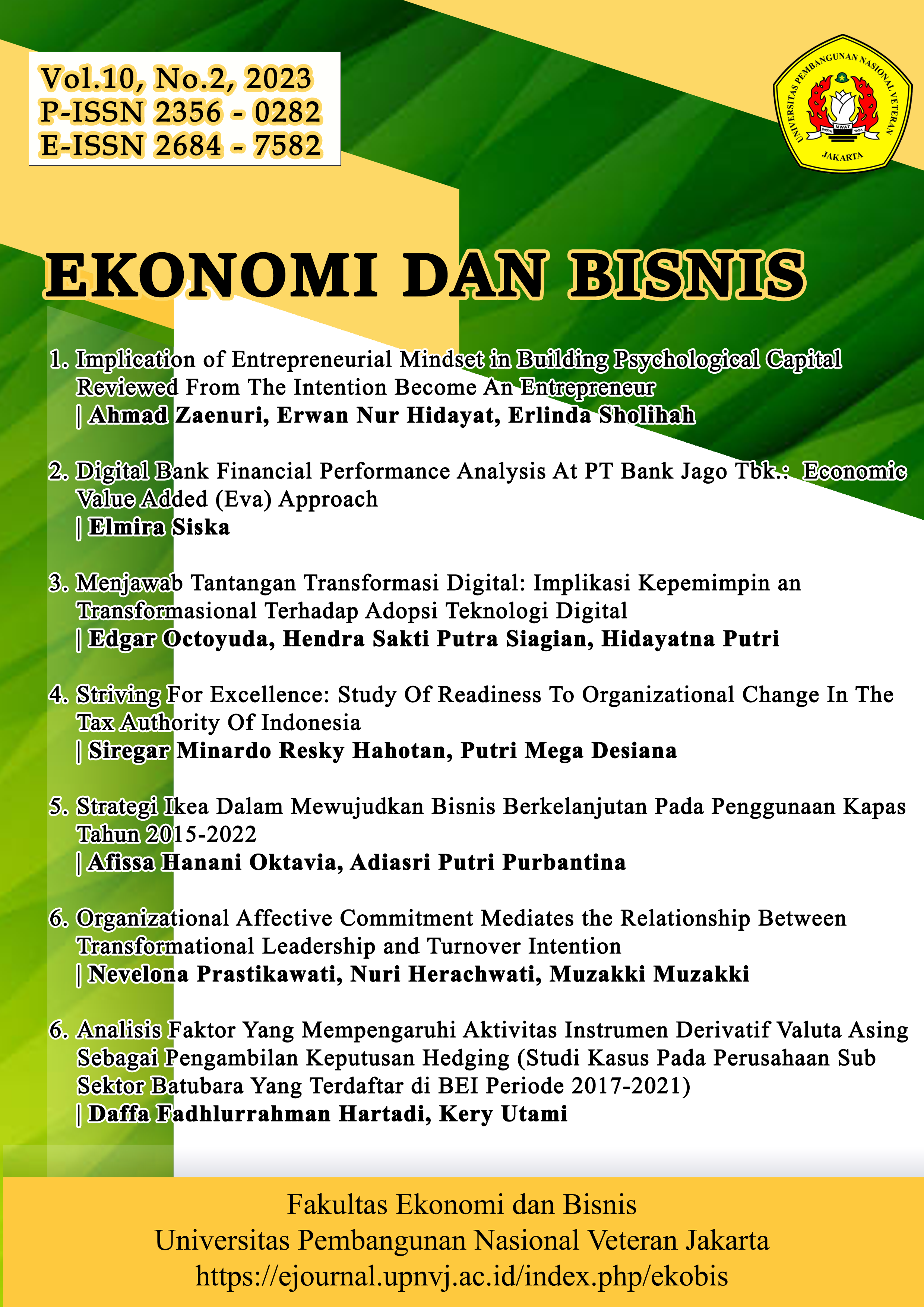
IMPLICATION OF ENTREPRENEURIAL MINDSET IN BUILDING PSYCHOLOGICAL CAPITAL REVIEWED FROM THE INTENTION BECOME AN ENTREPRENEUR
DOI:
https://doi.org/10.35590/jeb.v10i2.6918Abstract
The research aims to assess entrepreneurial mindset’s effect on entrepreneurial intention through psychological capital dimensions, i.e., resilience, optimism, hope, and self-efficacy. The paper develops the Theory of Planned Behavior (TPB) concept. This is a quantitative type of research using an explanatory approach. The specified population was final students of Universities at Semarang City. The sample was randomly selected by 200 respondents using Google Forms. Then, the method of data analysis applied was SEM-PLS with SmartPLS. The authors pointed out that entrepreneurial mindset significantly affects resilience, optimism, hope, and self-efficacy. Next, resilience also affects entrepreneurial intentions. Otherwise, optimism, hope, and self-efficacy do not significantly affect entrepreneurial intentions. This theoretical study’s contribution is expected to help extend the TPB concept and solve the problems related to student’s entrepreneurial intentions.
Keywords: Entrepreneurial Mindset; Psychological Capital; Entrepreneurial Intention; College Student
Downloads
Published
How to Cite
Issue
Section
License

This work is licensed under a Creative Commons Attribution 4.0 International License.
Authors who publish with this journal agree to the following terms:
Authors retain copyright and grant the journal right of first publication with the work simultaneously licensed under a Creative Commons Attribution 4.0 International License that allows others to share the work with an acknowledgment of the work's authorship and initial publication in this journal.
Authors can enter into separate, additional contractual arrangements for the non-exclusive distribution of the journal's published version of the work (e.g., post it to an institutional repository or publish it in a book), with an acknowledgment of its initial publication in this journal.
Authors are permitted and encouraged to post their work online (e.g., in institutional repositories or on their website) before and during the submission process, as it can lead to productive exchanges, as well as earlier and greater citation of published work.
This work is licensed under a Creative Commons Attribution 4.0 International License.