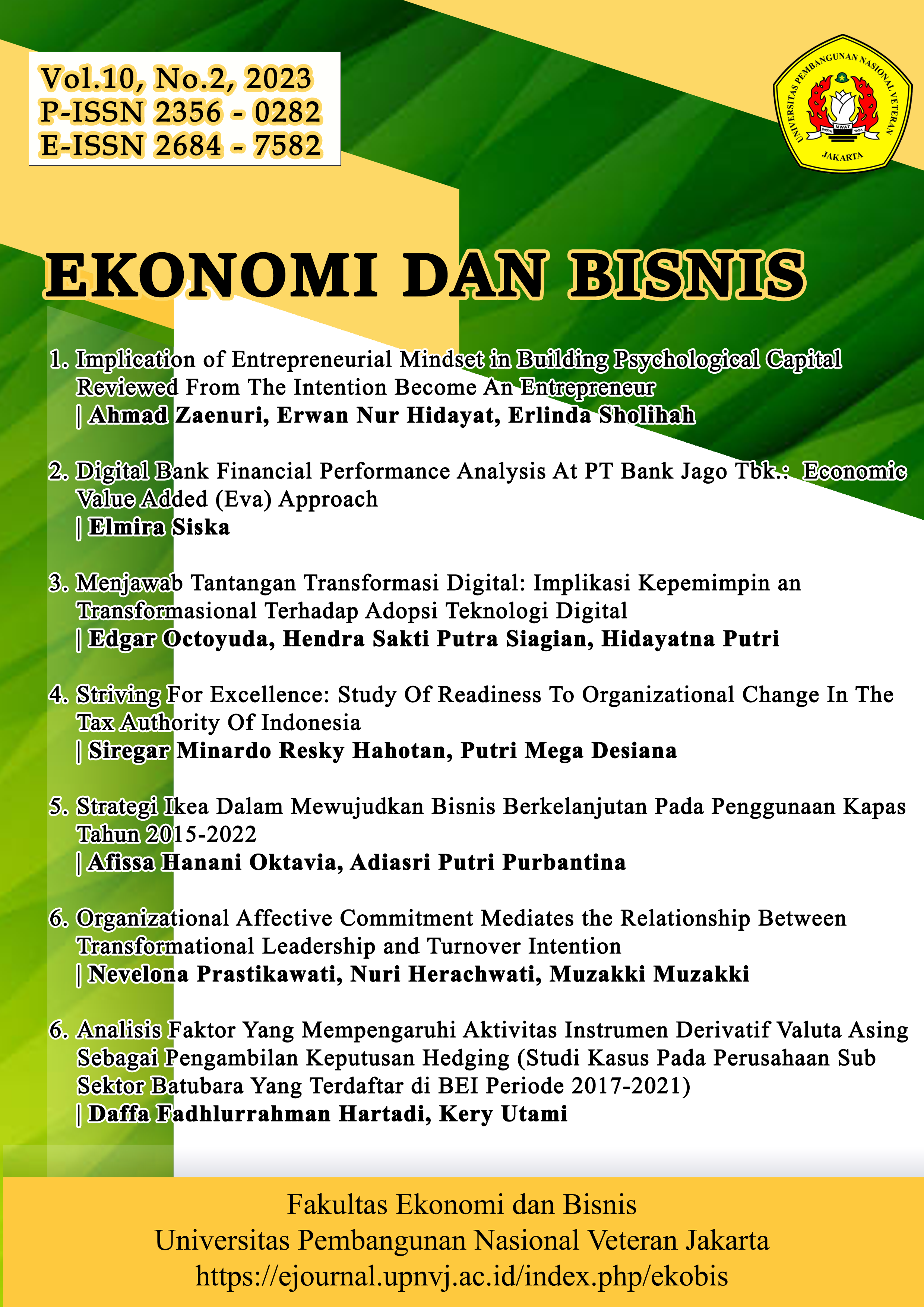
STRATEGI IKEA DALAM MEWUJUDKAN BISNIS BERKELANJUTAN PADA PENGGUNAAN KAPAS TAHUN 2015-2022
DOI:
https://doi.org/10.35590/jeb.v10i2.6721Abstract
Sustainable business practices are a form of responsibility for multinational companies in the midst of commitments to implement SDGs by countries affected by business expansion in running their production systems. In carrying out its business operations, IKEA continues to uphold business operation standards with continuous innovation. This company has adopted a sustainable business innovation model called IWAY Standard to fulfill its commitment to implementing SDGs in the industrial and agricultural sectors, especially in the use of cotton. This research uses a qualitative descriptive method and focuses on case studies to describe and analyze the implementation of the IWAY Standard in meeting the needs of IKEA cotton raw materials sourced from supplier countries. The data used in this research is secondary data using the Sustainable Business Model Innovation (SBMI) approach which is used to identify the implementation of the IWAY Standard in the use of sustainable cotton by IKEA from 2015 to 2022. The results of this research show that through the sustainable business strategy realized in IWAY Standard, the multinational company IKEA has carried out its environmental, social and economic responsibilities through three SBMI components, namely Sustainable Value Propositions Innovation, Sustainable Value Creation & Delivery, and Sustainable Value Capture Innovation which have been implemented by IKEA. These include program collaboration, solving sustainability problems, developing products and services, ratifying policies, organizing companies in a sustainable manner, building positions in tandem with stakeholders, as well as designing new sustainable income models and cost structures.
Keywords: Sustainable Business; IKEA; IWAY Standard; Cotton Raw Materials; and Business Innovation.
Downloads
Published
How to Cite
Issue
Section
License

This work is licensed under a Creative Commons Attribution 4.0 International License.
Authors who publish with this journal agree to the following terms:
Authors retain copyright and grant the journal right of first publication with the work simultaneously licensed under a Creative Commons Attribution 4.0 International License that allows others to share the work with an acknowledgment of the work's authorship and initial publication in this journal.
Authors can enter into separate, additional contractual arrangements for the non-exclusive distribution of the journal's published version of the work (e.g., post it to an institutional repository or publish it in a book), with an acknowledgment of its initial publication in this journal.
Authors are permitted and encouraged to post their work online (e.g., in institutional repositories or on their website) before and during the submission process, as it can lead to productive exchanges, as well as earlier and greater citation of published work.
This work is licensed under a Creative Commons Attribution 4.0 International License.