
| ..:: IN COOPERATION WITH ::.. |

| ..:: MEMBER OF ::.. |


| ..:: ACCREDITATION ::.. |
| ..:: CITATION STATISTICS ::.. |

| ..:: JOURNAL TOOLS ::.. |




Journal of Islamic Economics and Finance Studies provides a forum to promote the wide dissemination of knowledge and research in various fields of Islamic Economics and Finance.
This journal encompasses research articles and conceptual papers in the areas:
The practice of peer review is intended to ensure that only good science is published. As an objective method of guaranteeing excellence in scholarly publishing, it has been adopted by all reputable scientific journals. Our reviewers play a vital role in maintaining the standards of the Journal of Islamic Economics and Finance Studies.
Initial manuscript evaluation
The editors first evaluate all submitted manuscripts. It is rare, but it is possible for an exceptional manuscript to be accepted at this stage. Manuscripts rejected at this stage are insufficiently original, have serious scientific flaws, or are outside the aims and scope of the journal. The manuscript whose author doesn't re-submit the revised manuscript from editorial notes within six months will be rejected and allowed to make a new submission. Those that meet the minimum criteria are typically passed on to at least two expert reviewers for review.
Authors of manuscripts rejected at this stage will usually be informed within three weeks of receipt.
Type of peer review
The Journal of Islamic Economics and Finance Studies employs double blind review, in which the reviewers remain anonymous to the author(s) throughout and following the reviewing process. In the same time of reviewing process the authors also remain anonymous.
How the reviewer is selected
Whenever possible, reviewers are matched to the paper according to their expertise.
Referee reports
Reviewers are asked to evaluate whether the manuscript:
How long does the review process take?
The time required for the review process is dependent on the response of the referees. For the Journal of Islamic Economics and Finance Studies, the typical time for the first round of the review process is approximately 6 weeks, with a maximum of four months.
Final report
A final decision to accept or reject the manuscript will be sent to the author along with the recommendations made by the reviewers, including (if applicable) the latter’s verbatim comments.
The Editor in Chief's decision is final
Reviewers advise the Editor in Chief, who is responsible for the final decision to accept or reject the article.
This journal provides immediate open access to its content on the principle that making research freely available to the public supports a greater global exchange of knowledge.
This journal is published twice a year in June and December. Articles can be sent at any time, and the editor will publish according to the schedule
Papers submitted to the Journal of Islamic Economics and Finance Studies will be screened for plagiarism using Turnitin. The similarity index of paper for reviewing process is not more than 20 percent. Papers leading to plagiarism or self-plagiarism will be immediately rejected.
All authors are suggested to use plagiarism detection software to do the similarity checking before submitting their manuscript to the journal
Journal of Islamic Economics and Finance Studies (JIEFeS) was established on March 2, 2020, based on the Decree of Rector of UPN Veteran Jakarta No. 303/UN61.0/HK.02/2020. The journal published the first issue on August 8, 2020, the issue of Vol. 1 No. 1 (June 2020). The journal was launched formally by the Vice Dean III of the Faculty of Economics and Business, UPN Veteran Jakarta on September 19, 2020. At the same time, the journal has been registered as a member of Aliansi Pengelola Jurnal Berintegritas Indonesia (ALJEBI).
Starting from the issuance of Vol. 2 No. 1 (2021) the journal has updated the template, therefore the published articles in that number began to be published in the new template format. Meanwhile, the metadata format had been updated by including abstracts both in English and Indonesian together.
In July 2022, JIEFeS cooperated with the Central Executive Board of The Indonesian Association of Islamic Economists (DPP Ikatan Ahli Ekonomi Islam Indonesia) in reviewing and publishing journal articles.
JIEFeS was accepted for inclusion in DOAJ since 8 August 2022, while it will increase the visibility, impact, distribution, and usage of the journal content.
JIEFeS has been nationally accredited in rank 3 (Sinta 3) by the Minister of Education, Research, and Technology of the Republic of Indonesia for the period 2020 - 2025 (Decree No. 225/E/KPT/2022).
The journal then published articles fully in English starting from Volume 4 No. 1 (June 2023) and had increased the number of articles to 12 articles per issue to provide wider opportunities for academics and researchers.
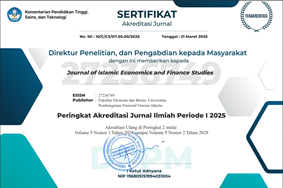
JIEFeS currently has been nationally accredited in rank 2 (Sinta 2) by the Minister of Higher Education, Science, and Technology of the Republic of Indonesia for the period 2024 - 2028 (Decree No. 10/C/C3/DT.05.00/2025).
| ..:: IN COOPERATION WITH ::.. |
| ..:: MEMBER OF ::.. |
| ..:: ACCREDITATION ::.. |
| ..:: CITATION STATISTICS ::.. |
| ..:: JOURNAL TOOLS ::.. |
Publisher:
Faculty of Economics and Business, Universitas Pembangunan Nasional Veteran Jakarta
MH Thamrin Building 1st Floor
RS Fatmawati Street, No. 1, Pondok Labu, South Jakarta, Indonesia 12450
Email: jiefes@upnvj.ac.id

This work is licensed under a Creative Commons Attribution 4.0 International License.