About the Journal
Focus and Scope
Informatik: Jurnal Ilmu Komputer accepts articles in the following research areas:
Internet Business Applications
The scope of Internet Business Applications covers a wide range of online business-related applications, including e-commerce platforms, marketing campaign management tools, web analytics, marketing automation, ride-sharing platforms such as Uber or Grab, flight booking platforms such as Expedia, project management tools, financial management systems, inventory management systems, and others.
Network & Cyber Security
The scope of Network & Cyber Security involves efforts to protect computer networks and data from security-related threats such as Denial of Service (DoS), brute force attacks, phishing, application security, data protection, identity security, mobile security, cloud security, and others.
Statistics & Computation
The scope of Statistics and Computation covers statistical applications in the context of computing and data analysis. This includes the use of computational methods to collect, store, manage, analyze, and present data using statistical techniques, such as data analysis, experimental design, simulation, big data analysis, statistical methodology development, data visualization, spatial and geospatial analysis, and others.
E-Learning & Multimedia
The scope of E-Learning and Multimedia includes the use of multimedia technology in education and distance learning. This involves the use of digital media, software, and online platforms to deliver learning materials, communicate, and interact with students, including instructional design, e-learning platforms, mobile learning, and others.
Robotics & Artificial Intelligence
The scope of Robotics and Artificial Intelligence involves the study and development of intelligent, autonomous robotic systems capable of interacting with their environments. This includes fields such as robotics, artificial intelligence (AI), computer vision, natural language processing, control systems, autonomous robots, human–robot interaction, medical robotics, and others.
Peer Review Process
All submitted manuscripts are reviewed by at least two independent reviewers. Acceptance is granted only after receiving two positive recommendations. Published issues will be available online for download (see: Archive section).
Initial screening: The Editor-in-Chief evaluates each submission to determine whether its topic and content are suitable for consideration by Informatik: Jurnal Ilmu Komputer. Manuscripts that do not meet the minimum criteria are returned to the author within two weeks of submission. Authors may then revise their work or submit it elsewhere, avoiding unnecessary delays.
Peer review: Manuscripts that pass the initial screening are assigned to an Associate Editor, who selects qualified reviewers based on subject expertise. Each manuscript is reviewed under a single-blind process, where reviewers remain anonymous. Reviewers are asked to evaluate the manuscript on originality, novelty, clarity, completeness, significance, methodological soundness, research contribution, and practical relevance. Based on the reviews, a manuscript may be categorized as Rejected, Revision Required, or Accepted as is. Reviewers are expected to complete their reviews within 5 weeks. The Associate Editor then makes a recommendation to the Editor-in-Chief.
Final decision: Based on the reviewers’ reports and the Associate Editor’s recommendation, the Editor-in-Chief makes the final decision and communicates it to the author, along with the reviewers’ comments. The possible decisions are “Accept Submission,” “Resubmit for Review,” “Reject,” or “Decline Submission.” Revised manuscripts must be resubmitted within 2 weeks and will normally be re-evaluated by the Associate Editor.
Publication Frequency
Informatik: Jurnal Ilmu Komputer is published three times a year: April, August, and December. Manuscripts may be submitted at any time via the online system (Registration). Submissions received from January to March will be considered for the April issue, those received from May to July for the August issue, and the remainder for the December issue.
Open Access Policy
This journal provides open access, making research freely available to the public and supporting a greater global exchange of knowledge. Readers are encouraged to register with Informatik: Jurnal Ilmu Komputer for readership data and visit tracking purposes.
Publication Ethics
Publication Ethics of Informatik: Jurnal Ilmu Komputer
This statement outlines the ethical standards expected of all parties involved in the publication of manuscripts in Informatik, managed by the Faculty of Computer Science, Universitas Pembangunan Nasional “Veteran” Jakarta, including authors, editors, and reviewers.
This statement is based on COPE’s Best Practice Guidelines for Journal Editors.
- Ethical Guidelines for Journal Publication
The publication of a manuscript carries important ethical responsibilities. Informatik publishes theoretical and empirical research papers that contribute to knowledge development. Each manuscript undergoes peer review to ensure scientific rigor. Ethical standards must be upheld by authors, editors, reviewers, publishers, and society at large. The Faculty of Computer Science, UPN “Veteran” Jakarta, as the journal’s publisher, is committed to ensuring that editorial decisions remain independent of commercial interests. - Publication Decisions
The Editor-in-Chief is responsible for deciding which submitted manuscripts should be published, based on input from editors and reviewers. Decisions are guided by the evaluation of originality, significance, clarity, and relevance, as well as peer review feedback. The editorial team oversees the entire process, including submission, plagiarism checking, review, layout, and copyright assessment. - Non-Discrimination
Editors and reviewers evaluate manuscripts solely on their intellectual content, without discrimination based on race, gender, sexual orientation, religion, ethnicity, nationality, or political beliefs. - Confidentiality
Editors and reviewers must treat submitted manuscripts as confidential documents. Information about a manuscript may only be shared appropriately with those involved in the publication process. - Disclosure and Conflicts of Interest
Unpublished materials disclosed in submitted manuscripts must not be used for personal research or gain by editors or reviewers without the author’s consent.
Duties of Reviewers
- Contribution to Editorial Decisions
Reviewers assist editors in making editorial decisions and help authors improve their manuscripts through constructive feedback. - Timeliness
Reviewers are expected to complete their evaluations within the specified timeframe. If unable to do so, they should promptly notify the editor so alternative reviewers can be assigned. - Confidentiality
Manuscripts received for review must be treated as confidential and should not be discussed with others except as authorized by the editor. - Objectivity Standards
Reviews should be conducted objectively, with clear, reasoned arguments. Personal criticism of the author is inappropriate. - Acknowledgment of Sources
Reviewers should identify relevant published work that has not been cited by the authors. Any similarity or overlap with other published papers must be reported. - Disclosure and Conflicts of Interest
Reviewers must not consider manuscripts in which they have conflicts of interest arising from competitive, collaborative, or other relationships with the authors or institutions connected to the work.
Duties of Authors
- Reporting Standards
Authors must present accurate data and sufficient detail in their manuscripts. Fraudulent or knowingly inaccurate statements are unethical and unacceptable. - Data Access and Retention
Authors may be asked to provide raw data related to their manuscript and should be prepared to provide public access to such data if feasible. - Originality and Plagiarism
Authors must ensure that their work is original. If others’ work or words are used, proper citation is required. Plagiarism in any form is unacceptable. - Multiple, Redundant, or Concurrent Publication
Authors should not submit the same manuscript to more than one journal simultaneously. Such unethical practices will not be tolerated. - Acknowledgment of Sources
Proper acknowledgment of sources is required. Authors must cite publications that have influenced their work. - Authorship of the Manuscript
Authorship should be limited to individuals who have made significant contributions to the research. All co-authors must approve the final version of the manuscript. - Hazards and Human or Animal Subjects
If research involves hazardous materials, procedures, or animal/human subjects, authors must clearly identify them in the manuscript. - Disclosure and Conflicts of Interest
Authors must disclose any financial or other conflicts of interest that could influence their research. - Fundamental Errors
When an author discovers a significant error or inaccuracy in their published work, they must promptly notify the journal editor or publisher and cooperate in correcting or retracting the paper.
Journal History
The journal was established as a platform for researchers to publish scholarly works in the fields of Computer Science, Informatics Engineering, Information Systems, Information Management, and Information Security.
Accreditation
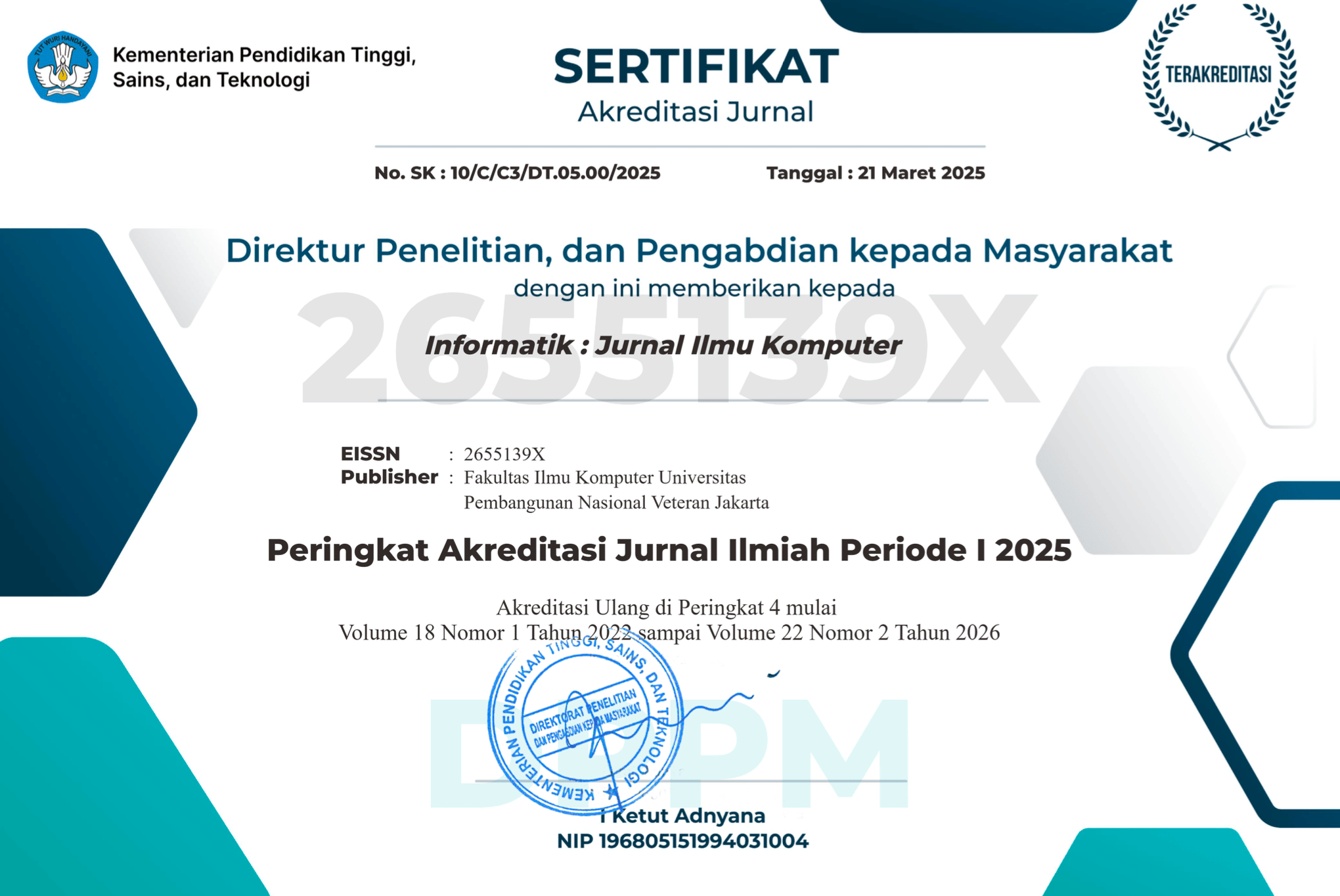
Informatik: Jurnal Ilmu Komputer is accredited SINTA 4 based on Decree of the Director General of Higher Education, Research, and Technology No. 10/C/C3/DT.05.00/2025 dated March 21, 2025, concerning the Accreditation Ranking of Scientific Journals, Period I of 2025.