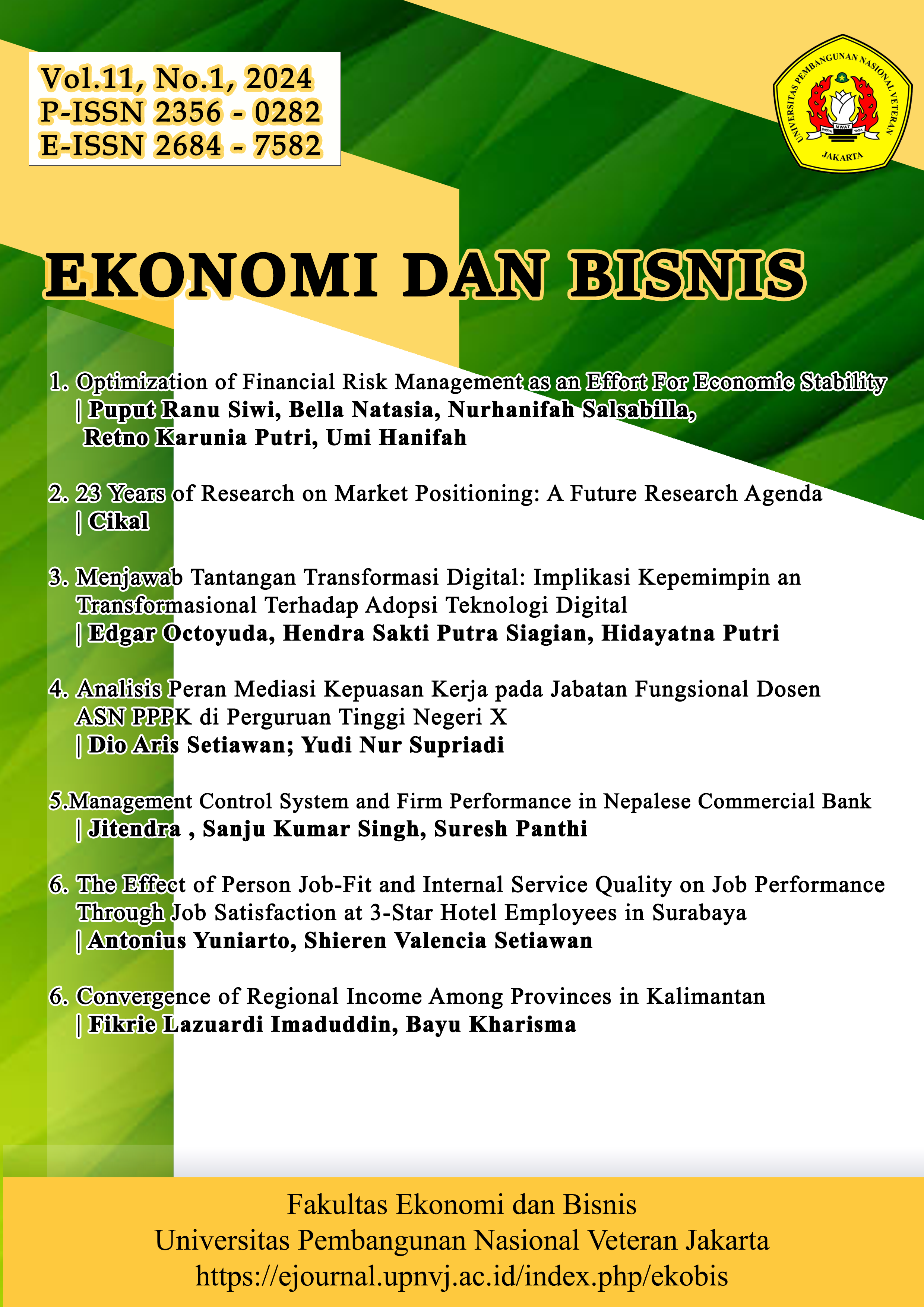
Management Control System and Firm Performance in Nepalese Commercial Bank
DOI:
https://doi.org/10.35590/jeb.v11i1.8209Abstract
This study focused on the interplay of control levers and organizational learning as well as the impact of Management Control Systems (MCS) on firm performance in Nepalese Commercial Banks. The study aims to examine the relationships between MCS levers (belief, boundary, diagnostic, interactive) and firm performance and assess the mediating role of organizational learning in this relationship. The study was done using descriptive and causal-comparative design, where a survey was carried out by deriving the responses from the employees of various commercial banks in Kathmandu. The findings of the study highlighted the significant correlations between MCS, organizational learning, and performance, highlighting MCS as a key tool for enhancing performance in the Banking sector. This study acknowledges limitations such as focusing only on Kathmandu and suggests future research to expand geographically and explore other sectors for broader applicability.
Keywords: Management Control Systems, Levers of Control, Organizational Learning, Banking Sector.e other sectors for broader applicability.
Downloads
Published
How to Cite
Issue
Section
License

This work is licensed under a Creative Commons Attribution 4.0 International License.
Authors who publish with this journal agree to the following terms:
Authors retain copyright and grant the journal right of first publication with the work simultaneously licensed under a Creative Commons Attribution 4.0 International License that allows others to share the work with an acknowledgment of the work's authorship and initial publication in this journal.
Authors can enter into separate, additional contractual arrangements for the non-exclusive distribution of the journal's published version of the work (e.g., post it to an institutional repository or publish it in a book), with an acknowledgment of its initial publication in this journal.
Authors are permitted and encouraged to post their work online (e.g., in institutional repositories or on their website) before and during the submission process, as it can lead to productive exchanges, as well as earlier and greater citation of published work.
This work is licensed under a Creative Commons Attribution 4.0 International License.